I want to tell you something that most communications firms don’t have the incentive to say.
The press release still matters. We write them. We time them. We place them. Done well, they are a critical part of any high-stakes communications moment.
But somewhere along the way, the press release became the entire strategy for most PR firms—and that’s exactly where companies are getting left behind. Sadly, “press release” are the only two words executives seem to know when designing a PR strategy. This is a critical misunderstanding. This makes it equally confusing in 2026 when the CMO is looking for more resources to pump up the volume on PR.
Gartner just backed up what we’ve been seeing in practice for years with data.
Press releases are among the least cited sources in AI-generated answers. Not because they’re worthless—but because AI doesn’t treat them as authoritative third-party validation. It treats them as what they are: self-reported announcements.
And if you’re a VP of Marketing or CMO at a B2B tech company approaching a funding round, an acquisition, or a moment where your CEO is suddenly asking why your competitors are showing up everywhere and you aren’t—the gap between what your agency is producing and what AI actually recommends is costing you more than you realize.
The search engine your buyers are using isn’t Google anymore
AI-powered tools like ChatGPT saw 608% traffic growth year over year between the first half of 2024 and 2025. Perplexity grew 262%. Traditional search like Google and Bing slipped 1%.
That shift matters for one specific reason: AI answer engines don’t favor paid media. They don’t reward the volume of announcements. They don’t surface the company that issued the most press releases.
More than 95% of links cited in AI-generated answers come from earned, shared, or organic owned content. When recency matters—and in deal cycles, it always does—nearly half of AI citations come directly from news coverage.
What that means in plain English: The company with the most authoritative earned media ecosystem wins the AI recommendation.
The press release gets you in the door. The consistency and strength of your entire media ecosystem—the bylines, the analyst coverage, the thought leadership, executive visibility and the third-party validation—is what AI actually reads, trusts, and recommends.
Most PR firms stop at the press release.
That’s the entire problem.
Here’s where it gets expensive if you get it wrong
I’ve spent nearly 20 years in this industry. Before Red Fan, I managed communications for JPMorgan’s Asia-Pacific portfolio. I sat on the buyer side of agency selection at LabMorgan and IBM Research. I know what it feels like to be the person in the room who understands what’s actually at stake—when no one else does.
And here’s what I know about high-stakes B2B moments: perception travels faster than truth.
When a PE firm starts due diligence on a $150M acquisition, one of the first things that happens—quietly, without anyone telling you—is an information search. Analysts, bankers, and board members ask their AI tools: “Tell me about this company. Who are they? What do they stand for? How do they compare to the category leaders?”
What comes back is a synthesis of everything that’s been written about you, by people who aren’t you, in places that AI trusts.
If your communications strategy for the last 18 months was press releases and a junior team managing your media list—the AI answer is going to be thin. Generic. Possibly wrong.
A press release announces the deal.
It does not build the authority that makes the deal land well.
And by the time you realize the difference, the narrative has already formed.
The seven brand signals that determine what AI recommends
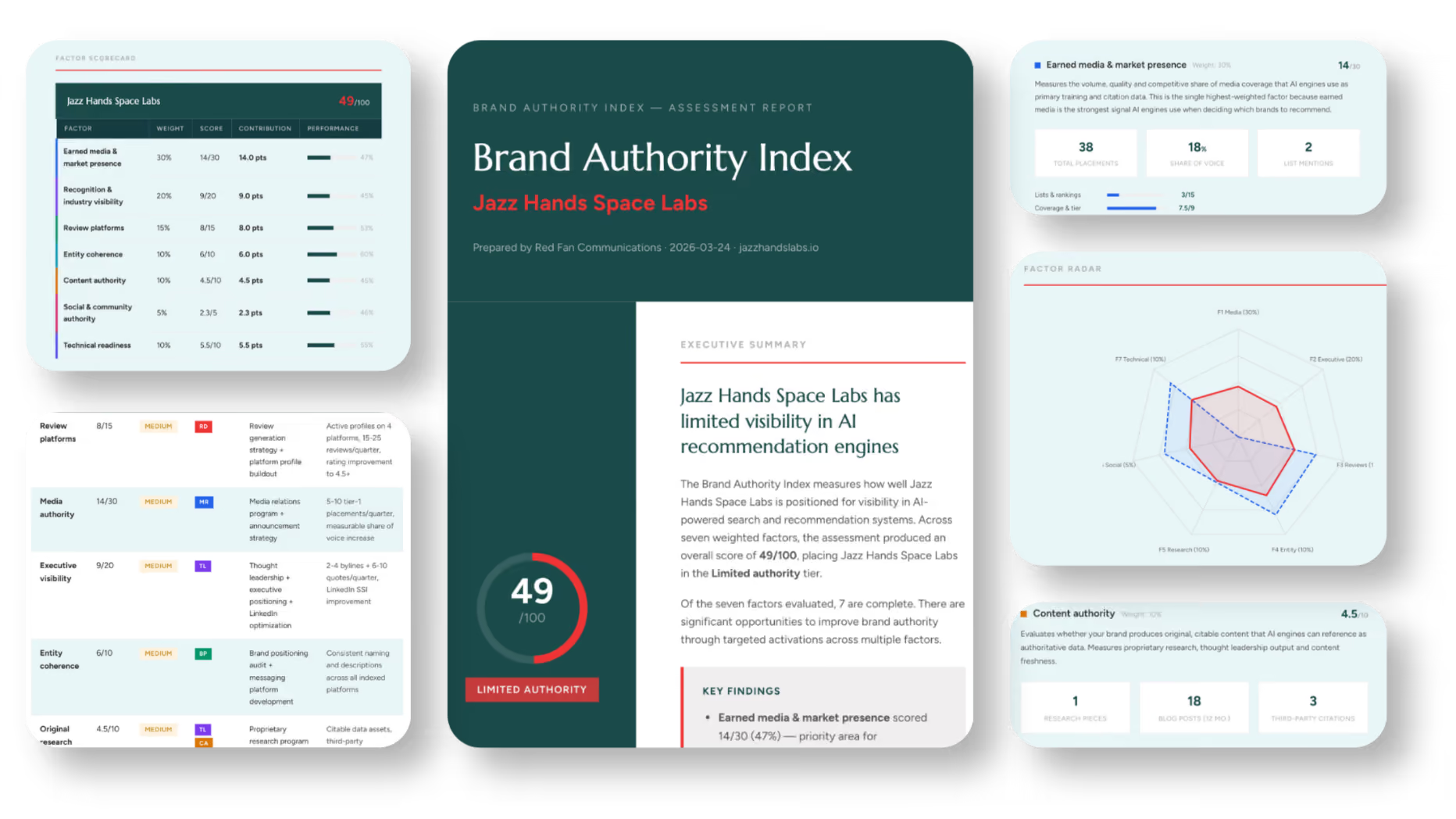
At Red Fan, we built the Brand Authority Index. It’s the diagnostic we run before we touch a single press release, write a single byline, or pitch a single journalist. It measures seven specific brand signals that determine whether AI search engines recognize you as a credible authority… or filter you out of the conversation entirely.
Those signals include the depth and diversity of your earned media, the strength of your thought leadership footprint, how consistently your narrative appears across third-party sources, and whether your positioning is specific enough for AI to match you to the right buyer query.
Most organizations we audit are scoring well in one or two signals and leaving the rest to chance.
That gap—between where you are and where you need to be before the next high-stakes moment—is exactly what costs companies deal value, competitive position, and board confidence.
Want to explore this together?
On June 17th at 1:00 p.m. CT, I’m hosting a free 60-minute working session with Matt Beezley, Red Fan’s senior strategist and the architect of our AI authority research.
In this session, we’ll walk you through the seven brand signals AI uses to decide who gets recommended—and show you how they play out differently across ChatGPT, Perplexity, Claude, and Gemini.
You’ll leave with:
- The language to explain brand authority to your CEO and board in terms they care about
- A prioritized action plan for closing the gap before your next high-stakes moment
Seats are limited. This is a working session, not a webinar you play in the background.
If you’re a B2B marketing leader who has a board meeting, a transaction, or a competitive pressure point in the next 6 to 12 months — this is the hour that will change how you think about what your agency should actually be building.
Register here.
And if you know a CEO or CFO who’s been asking why the marketing budget isn’t moving the needle—send this to them. The data alone will answer their question.
Kathleen Lucente is the Founder and CEO of Red Fan Communications, the strategy-first B2B tech PR firm behind billions in client transaction value. She leads The Positioned to Win Method™ — a four-layer communications framework built for companies navigating M&A, funding, and high-stakes growth.

Kathleen Lucente is the CEO and Founder of Red Fan Communications. With over 30 years navigating the tech industry's most transformative moments, Kathleen helps CMOs scale their communications strategies to match their companies' rapid growth. Her clients span the country—from Series B startups to billion-dollar companies positioning for their next milestone—all seeking the senior-level strategic counsel that has become her hallmark.