The queries your buyers are using aren’t the variable that determines whether an AI engine recommends your brand. Many of the tools sold into this category—those that show a brand’s rank based on a determined set of queries—assume it is, which is why teams spend a quarter chasing phrasing and see only marginal results. The engines themselves are the variable, because the same question asked twice does not return the same answer, and buyers rarely arrive at the question the same way to begin with. What you can influence is whether you sit in the set of companies an engine has enough corroborating evidence to name, in whatever form or fashion the question arrives.
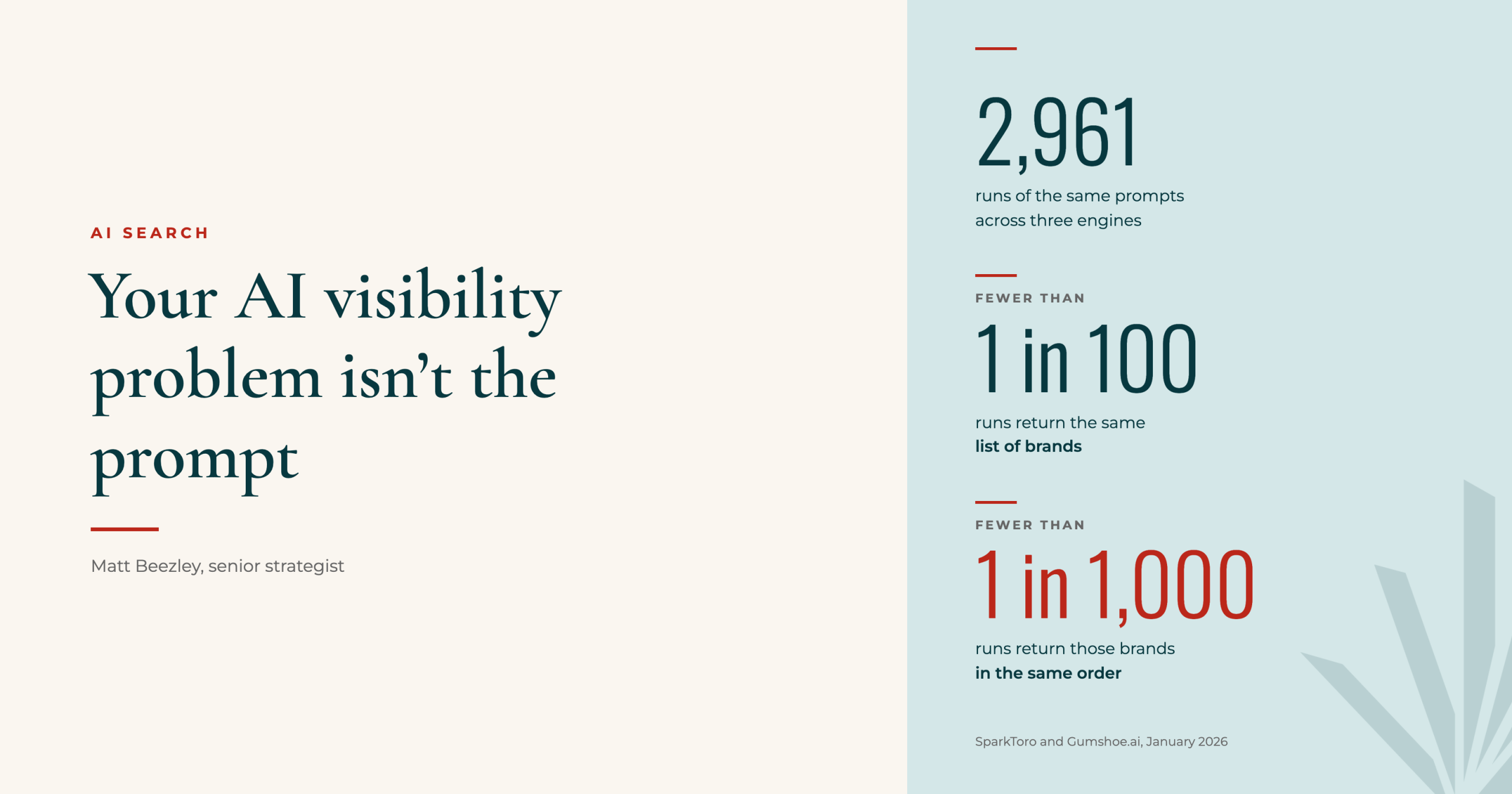
In January 2026, Rand Fishkin’s team at SparkToro ran a study with Gumshoe.ai that should have clarified the capabilities, limitations and value of brand rank tracking as a product category. Six hundred volunteers pushed 12 brand-recommendation prompts through ChatGPT, Claude and Google’s AI a combined 2,961 times. Two runs of the same prompt returned the same listed recommendation of brands fewer than one time in 100. Getting that same recommendation in the same order is closer to one in 1,000.
Then the researchers asked 142 people to write their own prompt for a single intent: headphones for a traveling family member. Average semantic similarity across those prompts came in at 0.081, roughly the distance between Kung Pao chicken and peanut butter.
Then the finding that matters: Across the 994 responses those 142 scrambled prompts generated, the same handful of brands surfaced 55% to 77% of the time.
That reframe is where Kathleen Lucente and I spent our second AI search session this month, and it raises the obvious follow-on: If not the prompt, then what is the engine reasoning over?
Mostly, other people talking about you. Muck Rack’s May 2026 analysis of 25 million AI citations put earned media at 84% of the total, a category that includes journalism, academic research, government sources, encyclopedic sites and third-party corporate content. These are pattern-matching systems corroborating dozens of sources before committing to a recommendation, which is why the old instinct to find the right phrase and say it louder moves so little.
There is also a source most brands never account for. When your buyer opens a chat to compare five vendors, the engine is working from more than its training data and the public web. Your buyer is pasting in their own notes, the deck your sales team sent, the recording of a webinar they attended.
Buy the forecast, but start with the climate
Most of our clients have already bought one tool or tested three. Semrush and Conductor shipped add-ons, though Adobe has since bought Semrush. Profound and Scrunch built for this from the start, and Sitecore bought Scrunch in June. Every PR monitoring platform is sending the same email. These tools are largely complementary, and what they give you is a daily weather report: a defined query set, share of voice against competitors, citation analysis, checked weekly. That is useful, and it is also a snapshot taken against query sets we now know are unstable.
Kathleen’s caution is the one I would carry into a budget conversation. Buy the tool you need for the daily forecast, but do not start there, or you may spend six months polishing a signal that was never the source of the problem to begin with. The climate read comes first. That is the job the seven brand signals do, and the three below are where our first-session attendees told us they felt weakest.
Recognition and industry visibility
When an engine decides whether to recommend you, it looks for named, credentialed voices speaking on your behalf in venues it already trusts. For most B2B companies that means the eight to 12 trade reporters and outlets that consistently cover your category, plus the analyst community. Bylines and SME commentary carry it, and customer stories carry it further, particularly a feature where your customer leads and your spokesperson supports.
Awards carry unusual weight because an engine reads an awards program as a third party that ran a competition and picked you. First Page Sage put awards at 15% to 19% of AI recommendation weight across an 11,000-query study. In that context, customer awards do double duty: validation from the program, plus a customer publicly championing what you sold them.
Two things Kathleen raised are worth putting in front of your executive team. First, the right spokesperson is often not the CEO. Plenty of CEOs will not commit the hours, and the fix is a bench of subject-matter experts with genuinely niche expertise covering topics relevant to buyers who will. Second, thought leadership is not a volunteer job. If your agency has to beg an executive into a byline every quarter, the problem is structural. The three or four people you name as experts are raising brand equity for the company, and that work belongs in their review process.
LinkedIn has been building toward a different way of ranking. In January 2025 its research team published a paper describing 360Brew, a 150-billion-parameter model built to handle more than 30 ranking tasks from a single system, and Kathleen’s read from client accounts since then is that reach has moved toward executives who consistently own a subject and away from those posting for volume. That tracks with everything else in this piece, because a system reasoning over a profile is reading the same evidence an AI engine reads. An executive who reshares a company link once a quarter is evidence too.
Review recency beats review rating
In a Brand Authority Index assessment we ran earlier this year, the client’s reviews looked strong. Good ratings, specific praise for the service, no obvious problem.
The reviews had not been updated in four years. A competitor held six times the review count on the same platform, most of it recent, and in our prompt testing the engines consistently looked past our client toward that competitor.
Recency bias runs through all of it, reviews and media alike, which is why a clustered review push every few years reads to an engine as a brand that stopped mattering. Muck Rack found more than half of journalism citations come from articles published within the past year, and citation volume drops sharply after the first six months. How heavily reviews count varies by engine, and Gemini leans on them hardest, so a review profile that looks adequate in one place can be the reason you lose in another. We have found prominent public companies sitting at zero reviews on platforms as load-bearing as Gartner Peer Insights, which leads review citations in Google’s AI Overviews.
The harder problem is ownership. Reviews live with sales and customer success, the AI payoff lands on marketing’s desk and brands have to decide who owns the ask to the customer to participate in a review, a case study, testimonial or awards program. Kathleen’s argument was that one ask should produce four assets: the review, then the case study, then that customer on the record with a reporter, then an award submission that makes the customer the hero. Most companies stop at the first because the internal handoff clogs.
Entity coherence, where the cracks show
Entity coherence is how consistently the internet describes who you are, starting with the four places engines check first: your website, your Google Knowledge Panel, Crunchbase and LinkedIn. Getting those four to agree is a short project.
It matters because the inconsistency is rarely the actual disease. When an engine describes you four different ways, something upstream is broken and it is surfacing well beyond AI. Executives tinker endlessly with the boilerplate or how they describe your brand to a reporter. The qualifier sentence in the press release changes with every announcement, which reporters read as an identity crisis, because it is one. Ask six executives for the elevator pitch and you get six answers. Sales teams have no consistent narrative and are left to tell their own versions, each noticeably different. Or the deal closes and that same week your team is on a trade show floor with no version of the combined story, while a competitor exploits the cracks in your messaging in their own pitches.
You used to be able to let that sit. AI does the hunting and pecking for buyers now, and it surfaces the inconsistency fast.
The lag is the point
The two client campaigns we walked through were built years before anyone at those companies worried about AI recommendations, which is exactly why they work now. Engines pull from the past, so the brands benefiting today, 90 days and six months from now are the ones already doing earned media, executive visibility and customer advocacy well.
Everyone else can catch up. What you can’t do is sprint it in a quarter, and going quiet after a burst of activity creates its own noise in the record. Start the diagnostic now for what it lets you say in the next board meeting: Here is where we stand, here are the three moves that change it in 30 days, here is what compounds by month 12.