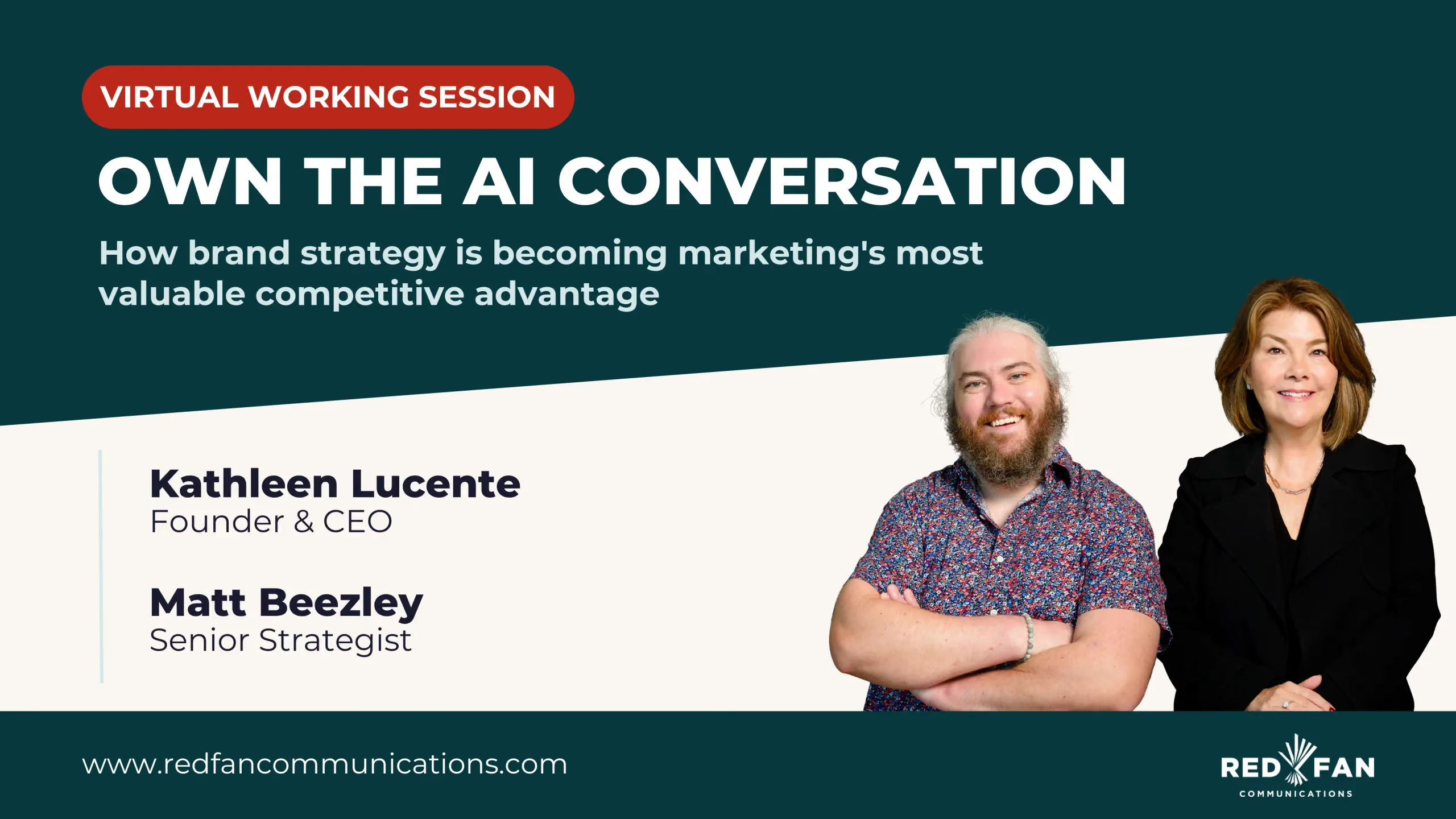
Red Fan Communications founder and CEO Kathleen Lucente and senior strategist Matt Beezley break down the seven measurable signals that determine how AI engines recognize, describe and recommend brands — and how marketing leaders can take the conversation back to their executive teams.
Webinar transcript | June 17, 2026 | Hosted by Emma Chase
Introductions
Emma: I’m going to introduce you first to Kathleen and Matt. For those of you who don’t know us, we’re really excited for you to hear from the team. Kathleen is our fearless founder and CEO. Before she built Red Fan, she was running communications for JP Morgan’s Asia-Pacific portfolio, and she sat on the buyer side of agency selection at LabMorgan and IBM Research. The long and short of it is that she understands where you’ve been. When we talk about pressure points — the conversations that are tough for you and your executive team — she has been in that room. For nearly 30 years she has been guiding B2B tech marketing leaders through funding rounds, acquisitions and the big moments where they want to be positioned to win.
Matt Beezley is our senior strategist, and he’s the person behind Red Fan’s AI research. He comes from a journalism background, which means he treats every claim like it has to hold up, and he built the Brand Authority Index, the diagnostic underneath everything you’ll see from us today. If you’ve been wondering how AI engines actually decide who to recommend, Matt is the one who has been measuring it. He and Kathleen are going to get into what that looks like, what the seven signals are, and the talking points you can take back to your team to confidently build your own brand authority. With that, Kathleen, I’ll kick it over to you.
The questions every marketing leader is hearing
Kathleen: Thanks, Emma, and great to be here with everyone. The big elephant in the room is the questions that keep popping up for VPs of marketing and CMOs. Not a day goes by that I’m talking to a CMO and don’t hear, “I got pulled into another meeting about how I’m measuring AI,” or “Five different tool companies are emailing me and I don’t understand which one to go with.”
These questions probably feel familiar — from your CEO, your head of sales, something in your inbox. Add any others that are driving you a little wild to the Q&A and we’ll address them. If you’re feeling frustrated, you’re in the right place. We’re here to help you get out ahead of this and own the conversation. No more being reactive. Let’s jump in.
Kathleen: Before we go further, let’s do a quick poll. Two questions. First: in the last month, has your board, your CEO or a PE partner asked how your brand is showing up in AI search? Second: how confident were you in answering?
Emma: Answers are rolling in, and no surprise — overwhelmingly yes on the first question, with a range of confidence levels on the second. Your answers are confidential, by the way, so feel free to be candid. It’s really just to get a pulse.
The promise
Kathleen: Our promise today is simple. In 60 minutes, you’ll have a dashboard you can build on your own, or build with us, to benchmark where you stand right now and use in how you speak to your executive team. You’ll have a blueprint for where you’re weak and where you’re strong across the seven signals, and a way to talk to your C-suite with confidence and consistency — then benchmark again and show how you’ve moved the needle. Ideally your sales team starts to say, “Now I see the connection between marketing and why we’re getting leads through Claude or Gemini or another LLM.”
Defining brand authority
Matt: You’ve heard Kathleen and Emma use the term brand authority a couple of times, so I want to define it. We’re all familiar with brand awareness; we know how important it is, and we’ve measured it for a long time. It sits at the top of the funnel for a reason. Brand authority is a term you may have heard elsewhere, but I want to define it properly, because we’ll bring it up a lot and we want you to be able to take it back to your teams.
At Red Fan, we define brand authority as the combination of the reputation you’ve built at the brand and market level and the trust you’ve built with each individual buyer — the belief and confidence, built over time, that when a buyer comes to you, your solution meets their use case. It might feel like the gap between those two is widening, and that’s because it’s where your marketing funnel used to sit. You could control it, measure it, track it, and proactively move prospects from awareness to conversion, building trust along the way.
That customer journey is now largely happening without you, in a chat window — ChatGPT, Claude, Gemini, Perplexity, the four LLMs we talk about most. Kathleen likes to say the funnel is now more of a spaghetti noodle, or a figure eight. Increasingly the sales cycle happens without you even knowing about it. But it also gives you an objective way to measure that gap. Once you understand how different LLMs work and the signals that underpin all of them, you can map those signals to specific marketing initiatives based on where you’re strong and where you’re weak.
What it looks like day to day
Matt: What does that look like day to day? If you haven’t gotten some version of this yet, you’re probably about to: your sales lead comes to you saying leads are coming from ChatGPT. Or it’s something bigger — we’ve heard clients say half their leads show up in the CRM as “source unknown” and they don’t know how to tag or track them. The good news is you’re probably already doing something right; you just might not know what. That lead built enough trust in your brand, increasingly through AI search, to show up ready to sign.
The signals we’ll walk through help you break that down — whether it was your media authority, an award an LLM cited, or a synthesis of customer reviews. That lets you say, “That’s an MQL we drove through a specific initiative,” put it in your quarterly reports and QBRs, and justify the investment. And when those prospects come through, ask the next question beyond “How did you find us?” Ask, “How did you research us?” That tells you whether there’s a specific model you need to focus on. There’s no rhyme or reason yet to which model a given vertical or audience uses, but you may start to notice trends specific to your brand.
The one stat that matters: 5% in market, 95% lurking
Matt: If I had to boil down all the data I’ve been sifting through over the past year into a single stat, it’s this, from the LinkedIn B2B Institute: 5% of any given market is in-market right now. The other 95% are moving through some version of a funnel without raising their hand. I’m a Redditor, so my version is that they’re lurking in your funnel. It’s a longtime-listener, first-time-caller thing.
Within that 5%, two follow-up stats matter for the conversation with your C-suite: 81% chose a vendor before they ever contacted sales, and 92% started with a vendor in mind. That’s direct proof of the difference between awareness and authority. The 95% is where authority gets built over time. There’s a tendency to focus on what we can fix in the next 30, 60 or 90 days, because that’s how businesses operate. But that 95% might not convert for 6, 12 or 18 months. You want to justify the investments that influence AI search now, so that when a lead finally makes themselves known, you know why.
The generational shift
Matt: There’s also a generational component. There are four generations in the workforce, but 71% of B2B buyers are now millennials and Gen Z — the two that default to AI as a research and decision-making tool. They champion their choice up to their Gen X or boomer leadership, and over the next few years they’ll have more and more purchasing authority. We have to account for that.
Kathleen: The generational research Matt has done — there’s a great piece on our website worth reading — really does vary. Millennials are leaning in, Gen X still wants the analyst or consulting report, and boomers stay skeptical. Everyone uses it, just in different ways. So you have to invest across the entire marketing ecosystem. One thing to recognize is that this work doesn’t replace what you’re already doing — events, demand gen, analyst relations, content, PR. All of it still has to happen, but it needs to happen with AI in mind. A lot of what you’re doing is great work; it’s about how you do it, how you measure it, and how you connect it to demand gen, which works very differently today. Getting everyone internally on the same page is a big part of marketing’s role, and marketing is the one that needs to drive that conversation.
Audience question: tracking leads across LLMs
Emma: Before we keep moving, a couple of questions. Jen asked if we can share Matt’s article — yes, we’ll get that to everyone. And Kevin noted that ChatGPT automatically applies UTM attributes to its links, making it easy to see a lead came from ChatGPT, but he doesn’t believe the other LLMs do this yet. How can we track the others?
Kathleen: This goes back to Matt’s point about getting the sales team to ask the right questions. The LLMs may not make those changes yet, so what has to change is the level of questions we ask — “How did you research us?” — and then segmenting that over a quarter so you can say, “Here’s what we’re seeing from Claude versus Gemini.” Matt, anything to add?
Matt: It has to be that, because there’s very little correlation in the specific domains the different LLMs cite. The underlying signals stay consistent, but whether they source the exact same URL? Almost universally no — the correlation is barely above zero. That’s why moving past the old SEO mentality into the age of reasoning that AI models use gives us a new set of measurements and KPIs. There’s no universal answer; it’ll come brand by brand, based on how your leads come through and what questions you ask when they make themselves known.
Emma: One more thing: there are monitoring tools — Profound is one — that add data on rankings and traffic. That sits a bit outside what we’re covering today, which is how to change the way the engines recommend you, but it can help complete the tracking picture.
The seven signals: an overview
Matt: We’ve been digging into the evidence base around AI search for the better part of a year, and new studies come out constantly. A few things to flag before we go signal by signal. First, to Kathleen’s point, this is not solely a marketing effort — different groups in your organization, or your agency, own different pieces. Second, these signals aren’t equally weighted. Some need to happen first but matter less in the grand scheme; others take longer to move but are disproportionately important to how models evaluate and recommend brands.
The signals group naturally. The first three — earned media, recognition and industry visibility, and reviews — compound as you invest across all three. Entity coherence, which is the AI term for messaging and brand-description consistency, and content authority are very controllable. And technical readiness, essentially website optimization, is the foundation everything else builds on. It’s the first step.
One more thing: the specific websites any given engine cites vary wildly across models. Some prioritize Wikipedia, others Reddit. So unless you have data showing your audience favors a specific model, avoid the temptation to “invest in ChatGPT.” The underlying signals stay consistent. ChatGPT had more than 90% market share eight months ago; anyone who built a playbook just for ChatGPT now has an irrelevant playbook. Rely on these seven signals — over the past year they haven’t changed, and they won’t, beyond slight adjustments as new research comes online.
Signal 1: Earned media and market presence
Matt: This is a vindication moment for us PR nerds, because earned media is disproportionately important to AI search. It’s the purest form of third-party credibility — a reporter chose to write about your brand or your customer, which then influences things like customer reviews and creates a compounding effect.
A study of 75,000 brands found the relationship between how much coverage a brand has and how visible it is in AI search is about zero. More coverage doesn’t mean more visibility — it’s the type of coverage that matters far more than the amount. The best example is list and ranking mentions: top tens, roundups, best-of lists. Those are far more influential than almost any other coverage. You see roundups more in consumer tech, but they appear in B2B too, and review sites are increasingly running them. And here’s the nuance I find fascinating: it doesn’t necessarily matter where you rank on the list, just that you’re on it.
AI models also have a recency bias that’s as important as volume, maybe more. What you earned in the last six months matters far more than what you earned 18 months ago. Seventy-one percent of ChatGPT citations come from content from 2023 to 2025. Kathleen asked me a good question yesterday: would you rather have one mention in The New York Times or a dozen in your tier-one trades? My answer was, how recent is the Times mention? If it was a year ago and the trades came in the last six months, I’m probably picking the trades. There’s nuance, but recency is real.
Kathleen: The point is the engine needs to stay in play. Whether you can earn a Times piece now or six months from now isn’t something anyone can promise. If you don’t have spokespeople or ongoing content and you’re living on past coverage, you’re not building the ramp for that 95% in the sales cycle. Everything you do now builds toward where you show up in AI later, and that needs to be understood internally at every company.
Matt: One more thing on this signal — Kathleen, you wrote a whole letter on press release strategy and whether it matters.
Kathleen: Press releases have a place in any PR effort. The problem is when people use them to replace SEO or earned media. It’s the pitching in advance, the interviews and the third-party credibility validated by journalists or analysts that make the difference. A press release on its own, without that effort, doesn’t get you where you want to be. I wrote an article about this recently. We see companies say, “We’ve got to get five press releases out a month,” and the thing is, AI picks up on slop. We talk about AI slop — well, AI knows AI slop too. If you’re pumping out releases instead of doing real media relations, it can actually tank you. Your PR partners should help you find the right time and approach.
Signal 2: Recognition and industry visibility
Matt: This is closely tied to the first. The most important sub-signal is the role your executives and subject matter experts play — in earned media, but also in what we’d traditionally call thought leadership. Are your executives visible? Are they talking about the right topics, consistently? If your CEO or an SME becomes known for one thing across three, four or five interviews or bylines, AI will pick up on that. Models need to put a proverbial face to the brand name; it’s one of the first things they check. If your executives have published recently, AI will pull it — maybe a press release quote, but ideally earned media or bylines. It also checks executive LinkedIn profiles: how often you post, what topics your CEO covers, how many followers they have. Those tactical things add up. The other big one is awards. When Kathleen and I search for Red Fan to see where we sit, the awards we’ve won do get cited. That’s not tooting our own horn; it’s an anecdote about how important an award strategy can be.
There are two layers to making awards visible. Any award you win should be on the landing page of the entity that issued it — I’m shocked at how often that doesn’t happen. Failing that, issue a press release; it’s a good fallback to make sure the award gets cited. Ideally there’s something in the earned space an engine attaches to, but the press release is an easy backstop as you build an award strategy.
Kathleen: On awards — in spaces like fintech, an award is often given at a closed-door event, so there may be photos. Get those out on LinkedIn. The LinkedIn authority piece is very important. We talk about building a cohesive brand narrative, but the executives you pick for consistency often aren’t using their LinkedIn profiles effectively. If you’re not familiar with 360Brew, the algorithm LinkedIn uses, it’s a strong piece. I spoke on an Austin Technology Council panel about a month and a half ago, and most people in the room had no idea about it. The LLMs are reading the posts and the profile, looking at engagement behaviors — not just keywords — and at relevance and expertise, to see whether your executive team actually maps to what you say on your website, in your releases and in your coverage. LinkedIn has far more authority with LLMs than most people realize.
Signal 3: Review platforms
Matt: This one boggles my mind. Over the last few years, review platforms — G2, Capterra, Software Advice — lost about 90% of their human web traffic, and AI search traffic replaced it at nearly one to one, which arguably makes them more important now than a couple of years ago. If you asked marketers how much they prioritize G2 these days, it’s probably been devalued, because people stopped reading them. But AI makes them one of its first stops. If a user asks Claude or Gemini, “What do customers say about this brand?” it goes to G2 or Capterra, synthesizes the reviews, and often gives a pros-and-cons list. So my immediate recommendation: go back and look at when your most recent reviews were.
A bit of a cheat code — I believe in February, G2 acquired Capterra, Software Advice and GetApp, so those reviews are now syndicated across all those platforms. G2 probably caught wind of how much it and its competitors were being cited and made a move to stay relevant. It also justifies customer storytelling programs that feed this signal directly — case studies, testimonials, awards that put customers front and center, a customer advisory board. Go back and see when your most recent reviews were and start reintegrating them; this is a medium-term signal that can pay off in the next 90 to 120 days.
Kathleen: You mentioned the other day that G2 and Capterra want to stay relevant too, so they’re pitching the media using their own data and rankings. As we said earlier, if you’re in a ranking and showing up well and promoting it, that’s another third-party signal that helps.
Matt: You can see how investing in one channel adds value in another, especially across the top three, because they’re all driven by third-party credibility.
Kathleen: The flip side: if your reviews are bad, or were bad in 2023 and you haven’t refreshed them, that will also tank you. There’s some ownership there to get it fixed.
Signal 4: Entity coherence
Matt: The next two you have more control over, and this one you can fix almost immediately. Entity coherence is your consistency across four major platforms: your own website, Crunchbase, Google Knowledge Base and LinkedIn. Your LinkedIn About page should match your Crunchbase description, which should more or less match your website. It comes down to details — where your headquarters is, whether your leadership is up to date. Things you wouldn’t think matter can make the difference between being cited accurately, being mashed together inaccurately, or not being cited at all. An engine looks at all four; if there’s wild variance, it either merges them inaccurately or skips you. These are quick fixes: go to each platform and standardize everything.
If you find a deeper messaging gap, that might tell you it’s time to update your messaging — because what’s on these channels may not be how you want to be portrayed, or even accurate anymore. One more: if you don’t have a Wikipedia page, look into it. It applies hyper-specifically to one model — 47.9% of ChatGPT citations come from Wikipedia. It can be hard to build one up, but it’s worth starting if ChatGPT is a model you need to focus on.
Signal 5: Content authority
Matt: A couple of myths to bust. First, and most important: more blog posts does not equal better AI visibility. In that study of 75,000 brands, the correlation between content volume and AI visibility was 0.194 — effectively negligible. People keep publishing more because it’s a legacy SEO mentality, where more content and more keywords meant higher rankings. That’s not how AI measures content. The biggest thing you can do is invest in proprietary research that’s highly citable for LLMs.
That leads to a discussion we have with clients all the time: do you gate or ungate your content? You need it gated to track leads, but ungated so it’s citable — because if it sits behind a contact form, AI treats it as if it doesn’t exist. The middle ground we’re finding: take the three to five most relevant, most citable data points, put those on a landing page, and build a blog around them. Ideally you get third-party coverage from that. Then gate the full report, the analysis and the commentary, so you can still track your leads.
Signal 6: Social and community authority
Matt: Two big points. LinkedIn is the first stop — AI checks your brand’s follower count, posting cadence and topics. The two that surprise people are YouTube and Reddit. Perplexity loves Reddit. If there’s a thread comparing your brand to another, it’ll pull it and cite what people are saying. Reddit is the last bastion of independence from the corporate world, so it’s harder to penetrate, but it’s worth monitoring; you can get creative with AMAs or a non-promotional brand presence. At a minimum, always be aware of it. YouTube is also a natural first stop — at a minimum, AI checks whether there’s a channel, when the last video posted, and how many are up. That can be a longer-term investment, especially if you’re building customer-story videos, but every model uses it as a checkpoint for whether and how a brand exists.
Kathleen: And you’d recommend transcripts be posted with the videos.
Matt: Correct — always post the transcripts.
Kathleen: To add on LinkedIn following and engagement: if you commit to one leader being out there consistently and use 360Brew, that gets picked up regularly, whether it’s YouTube video or LinkedIn. LinkedIn also recommends and ranks you by sharing your content with the audience it thinks is right. So if your CEO is one day posting about brownies when you’re an AI tech company, that disconnect can change things. Do an audit of your LinkedIn, decide which people to double down on, and sit with them to build out a platform and use 360Brew. It’s not that people are negligent — they just don’t know. Without a concerted effort, you can make a big difference for your brand.
Signal 7: Technical readiness
Matt: Last but certainly not least, technical readiness — basically, are you optimized for AI search or not. It’s often pass/fail, and your web developer can have this conversation with you. We’ll hand out a checklist afterward so you can take it to your dev and marketing teams and make sure elements like schema markup, crawler access and content structure across pages are optimized. This is the first stop for every engine: it goes to your website, checks whether you exist, then compares what your site says to what Crunchbase or Google Knowledge Base says. The real insight is that this is the thing you could literally fix tomorrow, and it’s the foundation all the other signals build and compound on.
Connecting the dots
Matt: Once you understand how the signals work on their own and how they influence each other, you can connect the dots, identify your strengths and weaknesses, and walk into your next strategic planning meeting or quarter-end review with far less uncertainty about which marketing initiatives will actually move the needle.
Audience question: can you direct the LLMs?
Emma: Two questions before we wrap. Jen, yes — you’ll get an asset with that data, and we’ll summarize the recording so you have a quick-hit list of Matt’s proof points for your talking points. And a good one from Matt Quirk: how might we help direct the LLMs to articles or social posts — is that even necessary?
Kathleen: Interesting one. As you’ve seen across these signals, some things you can control and others you can only indirectly influence, and every time a new model comes out, what it relies on shifts a little. Let me put real thought into that, and we’ll follow up with everyone.
Kathleen: It is really interesting. We’ve worked with partners who are replacing SEO with GEO and doing the media relations work. I saw a demo recently where a consumer product wasn’t showing up in Gemini, and then suddenly it was. It was about feeding the beast and watching where the change happens — which is what we’re trying to do: influence the seven factors. If you benchmark where you are now, then say, “Over the next 60 to 90 days we’ll strengthen these areas,” you can start to see what’s working. And if your sales team is asking the right questions so you can benchmark where leads come from, you connect the dots even more.
A quick self-assessment
Kathleen: One more anonymous poll. Based on these seven signals, take a minute and grade where your company is: strong, unsure or weak.
Kathleen: We’re seeing weaknesses across the board, particularly on review platforms — and that data is compelling. As marketers, we all know how powerful customer storytelling is, and it’s compelling to bring back to your sales and customer success teams. Lots of people are feeling strong on technical readiness — get that first box checked so you can start compounding on every other signal.
Matt: Technical readiness is so key. I’d add: if you’ve got executives constantly wanting to change the language on your website or LinkedIn, you probably need a huddle. You want consistency. When an executive team starts to noodle too much, it’s usually a sign it’s time to align on the messaging you need to stay consistent with — and to help them understand why changing things out causes problems. You’ll see it start to bleed into entity coherence.
Kathleen: It’s worth the time to get it right.
Closing: the Brand Authority Index
Kathleen: We’re going to give you two things, as Emma promised at the start. First, an email with a technical readiness checklist you can take to your web design team to double-check everything — it’s foundational, and you want to feel really good about it. Second, a guide on how to talk to your C-suite about AI: the five truths every marketing leader should be able to tell their executive team, with proof points, plus a recap of the seven measurable signals so you can build your own framework — or work with us to benchmark where you are.
We’ve been working hard and have built out the Brand Authority Index, so we can help you do that benchmarking — which is important if you don’t have the bandwidth to do it yourself. We have a special offer for everyone who came today. The single-brand evaluation looks at your seven-factor score across the LLMs, a gap analysis with an activation matrix, and an executive briefing on what it means and how to move it forward. The competitive set adds the one competitor your sales team keeps mentioning, with a comparison, a competitive positioning strategy and a challenger-brand blueprint. The authority roadmap is more robust, and we’ll have a call to walk you through which option fits. The Brand Authority Index is uniquely Red Fan’s — it’s customized and built on our own IP, and we’ve already been running it with a few clients who are excited to see where they can make changes.
I also want to show you the type of report that comes through — this is a mock-up, not a real client report. It lets you put this in front of your entire team and bring the right parties together: sales, brand, everyone who needs to align on the changes. You huddle around where you stand now, where you can improve and who owns what, then show your executive board where you’re making a difference and benchmark again to show the impact.
Emma: If you’re interested in learning more, you’ll get follow-up materials in your inbox today. You can book a call from that email to learn more about the Brand Authority Index and the other materials Kathleen mentioned.
Kathleen: You know where to find us. We clearly like talking about this and staying on top of the information, so we’re here for you. I love Sarah’s note in the Q&A — as marketers, we’ve got to stick together, and we’ve got each other’s backs. Thank you all for your engagement on the polls and in the Q&A.
Emma: We really hope this was valuable. Stay tuned for more in your inboxes today and in the coming weeks. Thank you, Matt, and thank you, Kathleen, for your insights. Enjoy the recording and the materials, and have a great rest of your Wednesday.

Emma’s passion for communications, technology expertise and B2B strategy across every major Red Fan vertical and service has laid the foundation for Red Fan’s growth into one of Austin’s leading strategic communications firms.