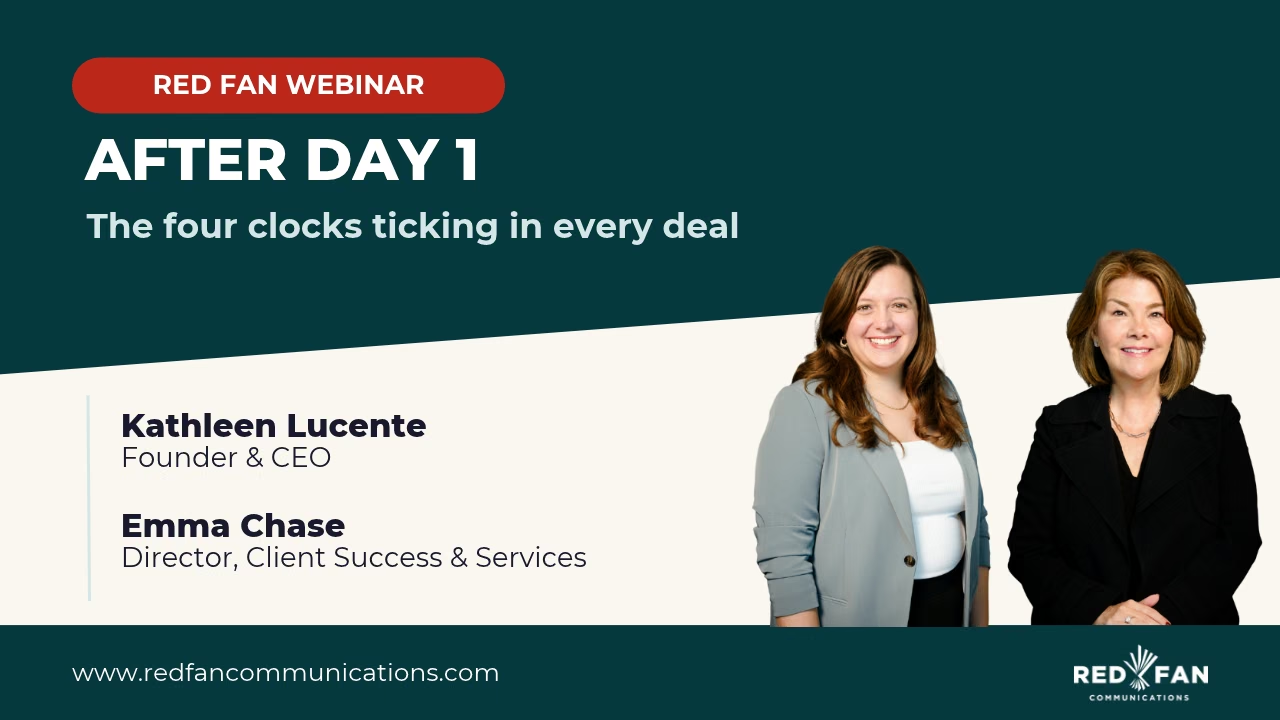
Red Fan Communications founder and CEO Kathleen Lucente and director of client success and services Emma Chase walk through the first 90 days after a deal announcement—how communications teams keep employees, customers, partners, investors, media and analysts aligned on deal value long after the press release goes out.
Webinar transcript, part 2 | Nov. 5, 2026 | Hosted by Kathleen Lucente and Emma Chase
The trust gap
Kathleen: They see, “Hey, you will have a role. There is life beyond day one, and here’s how we’re going to make sure we plan for that together.”
Emma: Life beyond day one. That’s the title of a memoir waiting to happen for you, Kathleen. We’ll have to make a note of that.
Kathleen: This is a very interesting one. Emma and I had a lot of fun with it because this is just the reality we’re seeing. Too often there’s a tendency—people are exhausted. We all have to remember the leadership team has been steeping in this for a long, long time, so they think they’re ahead of the game. The reality is that communications is just starting to execute on making sure employees understand what’s been going on behind all these closed doors. There are lots of questions and a lot to unpack.
If you look at the statistics on the right-hand side, acquirers who clearly articulate their synergies at announcement actually see a lot more return if they continue to communicate that value. In fact, the value is so high that McKinsey has an entire report on it. The other thing is that about 33% of startup employees leave within the first year, against 12% for comparable regular hires. That comes from MIT Sloan.
That’s often because of poor communications. Internal communications is probably the thing companies invest in least, and yet it’s the thing you need. It also often gets lost between the communications department, the HR department and the executive team. It’s kind of like “Who’s on first?” Who’s responsible for this? On top of that, middle management in most companies finds itself lost and not, I would say, catered to. Yet they could really be the champions of internal communications if you pull them into the fold a little earlier, really utilize them and empower them with the right information. And senior management at acquired companies has the highest attrition of any group in the building, so it’s not just middle management.
These are real issues. There’s a massive gap between what leadership thinks and what employees—and even your customers—are experiencing. Most teams think they’re maintaining momentum, but the drop-off absolutely says otherwise.
Emma: That delta between the dotted line and the solid red line at the bottom—we call that the trust gap. There’s the perception of what leadership thinks: “We did a great job communicating on day one, and we absolutely know the value of this deal,” or what this funding or strategic investment will do for us. That red line is the frequency of communications from before day one up to day 90. As it starts to peter out, the perception gap starts to grow. Your employees, your customers and your board are seeing things one way, while leadership is inundated with transaction activity. That’s a real delta. It can churn people, it can churn trust and it can even churn clients.
Kathleen: That’s a real risk—a big one. Emma, when we were preparing for this, you made a good point about losing a third of the people you acquired because you really weren’t communicating. The executive team has been so busy getting the deal done, but somehow the CEO hasn’t been visible—hasn’t been showing up and doing brown bag lunches, hasn’t really been connecting with the people of the merging companies or the existing company. When middle management feels disconnected and isn’t really buying into what’s happening, you can lose the value of the deal. It can literally slip right through your fingers. So investing in communications from day one and beyond is invaluable.
Emma: Natural attrition is to be expected, particularly in M&A. This is by no means a charge to keep every employee who comes in. We know there’s going to be natural integration, and many of those employees will find new ventures, especially if they’re coming from a young startup into an established organization. They’re going to want to find their next great startup adventure. But what happens when that expertise walks out the door? Did you communicate effectively with the rest of the staff so the acquired technology or capabilities could continue to be sold and continue to grow value for your customers? There are a couple of different ways to look at this, and risks at every turn. Getting into how we unpack that after day one will be helpful for the listeners today.
Poll: how long did deal communications run?
Kathleen: So we have another poll. Think about the last transaction, whether at your current company or a previous one. We’ve got the chart here as a reminder. How long did deal-specific communications run before you folded them into your ongoing marketing and communications?
Emma: Ongoing marketing and communications is whatever was on the schedule already: events, trade shows, email marketing, lead-gen activities and your internal communications, like newsletters and town halls. You would have disrupted those for deal communications. Did you collapse those two strategies right away, or did you let deal communications run a little longer?
Again, there’s no shame here. Communicating about a deal before, during and after it’s announced is highly resource-intensive. We just want a gauge from our folks. Did you go back to regularly scheduled programming two weeks in? Maybe about a month? Did you take two to three months for deal communications? Or maybe you haven’t experienced a deal yet and you’re thinking about what your strategy would be.
Kathleen: Or maybe management told you there’s another M&A right around the corner, and you haven’t even had a chance to breathe before weaving that into the story. Hopefully, as we talked about in Part 1, your management team has walked you through the growth strategy—that they’re planning a number of M&As or fundraising—so you’re communicating that to your stakeholders. Then by the time you announce something, it’s not a surprise. It’s part of an ongoing narrative your executive team has been communicating to different stakeholders all along.
Emma: One of my favorite things about what you’re zeroing in on, Kathleen, is that the communications and marketing folks in the room today are both the employees experiencing the communications and the people running them. That gives them such an interesting point of view on how the deal is communicated and whether all that pre-deal vision language and messaging from the executive team was landing or being activated—or maybe not. Looking at something like this, it’s, “OK, now we really have to make sure that’s all resonating.” Our marketing and communications folks sit at a really interesting precipice between those two dynamics, which is why I think we have one of the most critical roles in how a deal’s value is communicated.
Kathleen: We’re kind of like the litmus test, the reality check.
Emma: Absolutely. Thank you to everybody who responded. Again, it’s a mix. That’s normal, and it will be different for every workforce. Like Kathleen said, you might have another transaction imminent on the horizon. You may have a heavy M&A appetite as the company grows and scales, so that two-week to one-month timeline might be all you really have. Or you may be working with a two- to three-month stretch, or you haven’t announced one yet. Either way, there are a few considerations we’ll give you today that might help you have a really healthy before-and-after-day-one conversation moving forward.
The four clocks
Emma: Here’s how each of those tracks runs in parallel. When we talk about the four clocks, as Kathleen mentioned, these are the four stakeholder groups on the left. Each has its own timeline it operates against, plus the considerations, risks and tools you use to communicate effectively with it. We’ll break down each audience in the next section.
But one thing I want to highlight: Wouldn’t it be nice if we didn’t have this red line going through the graph? If there weren’t any competitors out there trying to disrupt all our beautiful communications efforts? If only we could dot every last I and cross every T of our communications plan without any disruption. But alas, there they are, right in the middle of our plan—probably causing less of a straight line of disruption and more of a squiggly line. That might mean that between days 1, 30, 60 and 90, you have to change your plan and be nimble. We’ll talk about that more when we get to customers and partners, but we want to make sure this secret fifth stakeholder group has its place in our discussion today.
Employees: the first 90 days
Emma: We’re going to start with employees. Think about it this way: All our clocks have reset. They were counting down to day one, and now we’re back to the start. New risks, new considerations and new opportunities for driving the deal message have presented themselves. So now what do we do?
As always, we’ll spend a little extra time on employees. We see such value in this stakeholder group. They are your champions and your advocates; the buck kind of stops with them. We want to start with how you go beyond the FAQ you probably labored over so intensely leading up to day one and really keep it alive. You did everything you could to anticipate employee questions before day one, but by no means do you have a 100% success rate. New questions are definitely emerging, especially as integration communications come out, as funding finds its way into the product roadmap or whatever the implications of the transaction might be.
So we’ll talk about manager toolkits and how executive visibility might change based on how your culture or workforce operates. Kathleen mentioned this too: What activities, like brown bag lunches or listening tours, do you have at your disposal based on how your team is built? Are you virtual? Distributed? Does your team come into the office a couple of times a week? Then, what does it look like when you start folding those communications into your ongoing internal communications?
You’ll notice that while we’ve been talking about long timelines beyond day one, we’re focusing on the first 90 days. That’s the minimum transition period we would use. Lots of variables determine whether your timeline might be longer—maybe it’s actually a 120-day window of ongoing deal communications. That depends on the nature of your deal. Mergers and acquisitions are different from funding rounds, which are different from private equity investments, which are very different from recently going public. We considered all those variables, but we want to focus on the first 90 days to make sure deal value is front and center.
I hate to say this, but we really hope everybody was at that first town hall about the transaction. Ask yourself: If someone missed it, where would they get information about the deal today? Your ongoing internal communications? A peer translating what they heard at the town hall, which we really hope resonated and landed? Or their manager, or their manager’s manager—that core group that needs to be empowered with the right deal messaging? The first 30 days after day one are mission-critical for capturing anybody who wasn’t available on day one. Maybe they were listening, but they were working on a critical project with a deadline that day. You want to make sure the message was fully heard and understood.
And I think every cross-functional stakeholder, Kathleen, is still actively communicating during this 30-day window: your executives, HR, the communications and marketing team and your middle management team, which is getting empowered more than it was before day one. Everybody is heavily activated during this time.
Kathleen: And your employees, too. They’re out and about. They’re reading social media and seeing how the news shows up on LinkedIn and how people are commenting. They’re at conferences. So they’re also a great feedback loop—they’re hearing what the man on the street is saying and what the competitor is saying. I was at a fintech conference the day an M&A deal was announced, and I heard people saying, “Oh yeah, they’re going to be a mess for the next six months while they integrate these two companies.” That was becoming the mantra. So you’re fighting against that kind of perception, and you need to empower your employees with communication that lets them say, “Actually, this is what’s going on, and it’s really quite fantastic. Here’s how my executive team is communicating with us. Here’s how my middle management team is communicating.” You have to define what success looks like for communicating with employees and how you’ll know you’re doing a good job.
Emma: That’s where the next 30-day period, days 31 to 60, comes in. You might be activating those brown bag lunches and maybe some mid-level listening tours, really getting your executive team activated. If your team is in person—maybe a slightly smaller team, 100 employees or fewer, that comes into the office fairly frequently—those intimate brown bag lunches are great for translating what was heard on day one into practical, closer-to-one-on-one question-and-answer settings. Listening tours let the executive team, as Kathleen said, gauge how things are actually landing. Are you creating more questions than you’re answering?
One thing we want to make crystal clear: Days 1 to 30 are when you make sure your mid-level management team is shored up. You may have brought them under the tent before day one, but maybe only about 24 hours in advance, depending on your risk appetite leading up to the announcement. So they’re also pretty new to this message, yet they’re now responsible for amplifying it on behalf of the executive team. Take a pulse within the first 30 days. How is it landing? Does it make sense? Are the toolkits helpful?
Then by day 60 or maybe day 75, two to two and a half months in, ask your employees how the messaging is resonating. We’re not talking about long employee surveys; employee satisfaction surveys are separate. These are two or three quick questions that go out to get a pulse check on how the messaging is landing.
Those listening tours and brown bag lunches will change based on your workforce model and your office versus virtual policies. If you’re a larger organization—200, 500 or 1,000-plus people—you’ll have to engage through some virtual opportunities.
And by day 90, we need to have had some feedback. That’s really what we’re aiming for. We can fold integration updates into regular internal communications once we feel there’s a collective understanding of what this funding will do, why we have a new ownership group or what this acquisition will do for the tech roadmap. If that understanding hasn’t reached parity across the organization, the timeline needs to extend. You have more work to do with your employees. You never want someone 60 days in saying, “Oh yeah, I forgot we had an acquisition a while back. I haven’t heard anything about that,” or “I’m still not quite understanding where that falls on the roadmap.” If that’s happening internally, the risk of it leaking externally can grow and grow.
Kathleen: One hundred percent. Or “Why do two websites still exist? I’m getting questions from customers, and it’s making it awkward for us as employees.” The full integration strategy needs to be explained, not siloed. Employees aren’t their own silo. They need to understand how the company is handling the merger of these two companies so they aren’t left feeling isolated. That’s the worst. Feeling isolated is the death knell for an employee feeling connected.
Bringing the FAQ to life
Emma: Couldn’t agree more. We’ve got a couple of communications tools listed in the bottom left, and on the next slide we bring a few of them to life. Again, how do you translate that beautiful FAQ? I keep calling it a beautiful FAQ because we’ve all had our hands on that document. You spent so much time trying to anticipate every question your employees and customers would ask. It’s such a critical piece of the communications playbook, but it can’t be a static document. It has to grow and evolve with you. It should live somewhere employees can access it, and it should change as early as the first week.
Kathleen and I talk all the time about how tired we know teams are when day one hits. All you really want is a day off to come back fresh. But as she said at the beginning of our time today, day one is when things really kick off and start to resonate. You start to get feedback. So we need that cross-functional group in place, so no one person is responsible for carrying the message forward and there’s balance across the team.
A few of these tools might help extend the communications call to action to others: the executive team, middle management and so on. If your team is largely in the office, consider brown bag lunches with your CEO, maybe pulling in your chief financial officer to share deal metrics as they relate to growth in company revenue. Consider small-group drill-downs, too—maybe by team. They’ll be more frequent on the calendar, but you avoid a meeting where nobody feels they can talk because there are 25 other people in the room. You want people to feel empowered to chime in with their own questions.
If you have a distributed workforce, virtual is the way to go. We’ve all been in virtual meetings that weren’t as engaging as they could be. But think back to the last one where you thought, “Wow, that was a beautifully facilitated conversation.” That’s the kind of meeting we mean, where you’re using the full extent of your Zoom capabilities: breakout sessions and interactive polling, like we’re doing on this webinar. I’d also encourage keeping these meetings a little smaller. We’ve all been in the virtual meeting where you can turn your camera off and listen with one earbud in. Ideally, your chief executive isn’t just talking at people for 30 minutes. They’re asking questions. Maybe a few middle management representatives are in the room to help spur conversation. These don’t have to be one-way presentations.
If you have a team that’s heavily on the road—maybe your sales team, highly distributed and always traveling for customer or site visits—it’ll be really hard to nail them down for options one or two. We’ve seen some really creative uses of internal podcasts or videos for team members who only have a couple of minutes to catch up on the road. A large tech provider here in town—I won’t name them—has a large distributed sales team across the country, and we’ve seen them put out high-quality internal podcasts about once a week. You pop in for five minutes and get a quick download of what’s happening. Kathleen, I know they’ve found other creative uses for those podcasts, too—not just big deals like this, but customer wins and how to answer questions creatively. That creates connective tissue with what you heard at the town hall. Maybe you can’t make the next meeting, but you can get a quick readout on one of these podcasts.
Kathleen: The head of sales in that example—it’s such a cool example because it started from a need and then evolved. The sales team could see how many people were actually tuning in. You can see how many people open a document, for example, and it looked like the entire sales team couldn’t open it because they were road warriors. But they could tap into a podcast. So you have a whole new nurturing channel for people who are on the road all the time. It’s a big one for consultants, too; that’s just the culture of those companies. It’s a great example and a smart investment, because they can also measure the ROI on how engaged the sales team is. And obviously you want them engaged.
Emma: Absolutely. And what a great way to diversify the communications you’re sharing, so you’re not inundating the team with emails. Especially in a heavy selling season, the last thing you’re prioritizing is internal email from your company. You’re looking at what your customer wants next, solving problems and putting out fires. So pushing this to the team in a way that fits their day is a really effective way to evolve that FAQ for your workforce. There are millions of ideas we haven’t even thought of here based on the specifics of your own culture. Maybe you have satellite offices. There are all kinds of considerations to explore based on what will work best for your team.
Customers, partners and competitors
Emma: All right, customers and those pesky competitors. Here they are again.
Before day one, we talked a lot about battle cards and anticipating, to the best of your ability, what competitors will say—putting yourself in their shoes. What would you say if you saw a deal like this come through for one of your competitors? So make sure those aren’t just refreshed but, much like your FAQ, constantly updated across this timeline. Usually before day one—and we talked about this last time—you’ve identified your tier-one customers, and they were nurtured in advance of the announcement. Tier-one follow-up is also mission-critical during this next 30-day phase. The last thing you want is to get lost in whatever technical or implementation conversations are happening right now. Don’t get me wrong, I know those are high priority. I’m not suggesting you ignore what’s actively happening with the customer.
But you do want the relationship to stay warm and nurtured. Ideally, it’s an opportunity for future cross-sell or a boost to retention. Those should all be assets to you. If your sales team feels it isn’t getting the right information or can’t translate the deal information, that’s an opportunity to update your battle cards or talking points. Much like in the employee section, we’ll talk about what feedback sessions can do for you, previewing roadmaps and so on. And when do integration milestones start getting communicated? This may be a little aggressive for this timeline. We’re not saying you need a full product roadmap baked and ready to go, but if you have some of those ready, now’s the time to use them.
The question to ask yourself: Do your account teams, client success teams and BDRs have something new to say at day 30, or are they still reading from the day one FAQ? There’s probably a version where that’s OK. If your day one FAQ is rock-solid and nothing has changed, maybe that’s fine. It’s not ideal, though. You want to show progress or momentum since the announcement, even if it’s, “Integration is underway. We’ve already had two or three internal meetings about this. I’m really excited about what’s to come in the next one to two months.” Maybe it’s, “We’re about to do a roadshow with our CEOs, and the next thing I want to do with you, Mr. or Ms. Customer, is schedule a listening session with our CEO.” You don’t have to have a cold, hard update for them, but you want to show progress and momentum.
In days 1 to 30, those follow-ups with tier-one customers are happening, and your battle cards are probably pulled up on your desktop all the time. You’re getting feedback from customers and listening to what’s happening in the market. If you’re at trade shows talking with customers—or maybe even eavesdropping on your competitors in the next booth—you’re feeding that into your messaging strategy. And don’t forget to feed it back to communications. They need to know what’s happening, because it has implications not just for customers but for partners, media, analysts, your board and definitely your employees. This is a time of high volatility. As Kathleen said before, containment is gone. The message is out. What are you doing to wrangle it now that it’s out in the world?
Kathleen: That’s a great point, Emma. This is the idea of having an under-the-tent project team, so if you’re out and you hear something concerning, there’s a way to get it back quickly. You don’t have to think, “Oh, I have to remember this when I get back.” There’s a point person, your head of communications, you can quickly send a note: “Hey, this is what I’m hearing right now. I wanted to get it to you so we can address it.” Because the problem is, the day goes on. You’re at a customer dinner, and that concern has floated out of your brain, but it’s still very much there. That’s what the under-the-tent team is all about. You know who your point person is when you see a communications concern and how to get it back to the team. Then they can evolve the FAQ, maybe have a call with that customer later or treat that customer to a specific conversation with the CEO—making sure nothing falls through the cracks.
Emma: Yes. And much like with employees, we need to have those feedback sessions by day 60 at the latest. That feedback needs to be rolled up to your board and obviously to your executive team. It’s the type of feedback that will change and mold not just your active communications but maybe even how you market future products as a result of the deal. All of that is great fodder for marketing communications and your larger stakeholder team.
I also want to zero in on partners. We’ve paired partners with customers for a reason. The partners you work with to service your customers may also be servicing your competitors. Maybe you have a beautiful list of exclusive partners, but for the most part, your partners also work with your competitors or other peers in the industry. If they’re watching an integration, or poor roadmap management after a funding injection, that’s another way for the message to slip out of containment and out of your control. Those partners need to be communicated with as if they’re internal client advocates. Make sure customer support, contracts, product enhancements or adjustments—whatever it might be—are communicated as soon as possible. Again, maybe a slightly aggressive milestone. We know there are financial, legal and operational implications following any deal. But make sure there’s a very clear plan for your partners so they feel absolutely catered to, and there’s no risk that how they communicate with your customers or other peers spoils the message in the field.
Investors and the board
Emma: Investors and the board are a really intriguing and untapped stakeholder group, particularly for the communications team. Think about the graph we showed earlier with the trust gap between executives and employees. I’d put investors up on that dotted line with executives. They, too, have been steeping in this deal for a long time. They absolutely understand the value. They endorse it. They signed off on it. Some of them may now be on your board.
So how are we leveraging them after day one? They might not be a very engaged board, or an investment team that wants to be that engaged. Their engagement may stop at your CEO or the core team supporting the ownership group. But depending on how the board is made up, there are untapped opportunities your communications team can activate. I think this is also one of the clearest opportunities for communications to have a seat at the table—not just before day one but across this entire timeline—to show the impact of the deal. How is it affecting not just our own brand reputation but all the stakeholders connected to it?
Once again, we’ll break this down by your board’s level of engagement. Ask yourself every step of the way: Are they still championing this deal, or have they already moved on to the next one? They might sit on other boards or be watching multiple investments. What are they doing for you?
If they’re more passive, that doesn’t mean they don’t get updates. They’ll be part of the regular reporting cadence, which hopefully includes some competitive intelligence at this stage. We’ve been listening for competitive disruption through our customers and partners, and we want to report on that regularly. We also want them to keep getting updated talking points. We really hope they use every beautiful talking point you put together for them. At a minimum, as things change and evolve, they need to have those at their fingertips.
Things get really interesting the more engaged your board is. A high-engagement board is prioritizing rapid growth. They’ll care about what your coverage looks like and how sentiment is changing month over month. Did we outperform on something like share of voice this month? Did we really capture the market over our competitors? They want to see that in deal postmortems. And they’ll really be watching what day one promises we made and whether we’re delivering on them. Is our product roadmap advancing the way it should? Are we being covered that way? Do analysts understand what we’re doing? Are customers responding in a way that drives revenue?
If board members are sought-after industry experts, there are really fun opportunities after day one: customer conference appearances, using their social channels for ongoing amplification of your messaging, using them as speakers or collaborating with them on thought leadership. If you have an executive chair who’s dedicated to your team—maybe a former founder who became executive chair—there’s a lot of fun work you could do together from a PR perspective. That keeps the cadence moving, keeps them engaged and uses their position in the industry as an asset to build credibility with your customers. So there are a lot of cool cross-functional opportunities between your investors, the board and your customers or partners.
Kathleen: Emma, I was thinking about how long we’ve been in this role. Board members—especially sought-after industry experts or movers and shakers, which most board members are—can be so valuable here. I remember a client where we did some research with incredible results. We were using it for ongoing thought leadership, and when we gave it to the board, one member said, “This is the first time I’ve had something I feel I can take forward to my network.” And that brought customers in. Giving them data and information that empowers them to have better conversations and brag about what’s going on is really important.
The flip side is that you definitely don’t want an industry expert or board member to be out somewhere, find out things are slipping and be embarrassed because they were caught off guard. You can’t blow sunshine at the board. It has to be straight up, because they’re out there. They’re movers and shakers. They’re either helping you, or they’re hindering you by not talking about you. If you have a strong relationship with the board and start making those connections early, you’ll get a read on who values what type of information and how each of them might help the company in different ways. It’s very cool.
Emma: Agreed.
Media and analysts
Emma: Media and analysts are where the mark of a real communications strategy is perhaps most visible externally, and fastest. You’re either getting the coverage or you’re not. Your analysts are either engaged or they’re not. The messaging either resonates with them or it doesn’t. So there are lots of criteria to examine with your PR team here, and then the question of how to keep the story alive. Is there something we can keep talking about related to this merger? Or is our product roadmap stretched so that we won’t have proof points for another six to 12 months? If so, how are we communicating about it?
It’s all about transparency and making sure it maps back to the vision. When Kathleen talks about the promises you make on day one, your media are watching that very closely. They quoted you saying X, Y or Z would happen as a result of this funding: “We’re going to hire 50 people. We’re going to grow our presence in Austin. We’re going to release new products over the next year. We’re on track for an exit in the next two to five years.” That’s all on the record now. It’s out there. It’s feeding AI engines. It’s shaping the future of your company in ways you may no longer control, because you’ve released it onto the record and into the wild. So what are we doing to keep this group engaged, and how are we factoring in our analysts? That depends on your schedule, the briefing opportunities you have and where customer stories start to come in to create an evergreen, always-on engine for your media strategy.
Let’s talk about analysts first, really quickly. If you run a regular analyst schedule, you’ll have a briefing sometime after the deal, because ideally you’re briefing once a quarter, or at least a couple of times a year. So you’re in the window to prep for that next briefing.
What will you say if your integration results, product roadmap results or whatever the deal’s implications were aren’t ready yet? This is where your mission, vision and long-term company vision language is really important. If your CEO said one thing before the deal and it’s already starting to change, or doesn’t follow a natural thread, your analysts will sniff that out immediately—especially if you’ve been in regular conversation with them. They’ll ask, “I thought you told us in Q2 you were focusing on X, Y and Z products this year,” or that your customers had told you this. “Is that strategy changing?” You need to be prepared for those conversations if you are changing strategy.
From there, it trickles out into how you portray it to media and so on. It’s OK if integration results aren’t ready yet. You just need to be able to say, “Here’s my vision. Here’s the plan.” There are a lot of similarities between how you’d speak to an analyst and to a customer, and that’s purposeful. Your analysts and consultants advise your potential customers on what they should or shouldn’t buy and what will be most valuable to their organizations.
So during this time, your external messaging, much like your internal FAQ for employees, should be rapidly evolving. Your PR team should be coming back to you with: Here’s what I’m seeing in the market. Here’s what our coverage looks like. Here’s what competitor coverage looks like. Here’s what general deal momentum looks like in this space. What’s our white space? What’s our opportunity to grab? And if we won’t have integration results or technology results tied to recent funding, what do we have? What evergreen thought leadership are we running right now that maps to the larger vision? That’s a lot to balance. The messaging pillars need to be rock-solid to translate between what you’re telling analysts, how your product roadmap is moving and how you’re translating that to the media.
In the first 30 days, you’re doing that analysis, reviewing your coverage against your deal goals. You might be doing follow-up interviews. If you were a surprise-attack CMO or head of communications, you may not have had much time for embargoed outreach, or even time to take media interviews in that first five-day window. Those might happen in weeks two or three after day one, depending on media availability. So you’re starting to get real-time feedback from those external channels to feed your messaging strategy going forward.
In the second window, days 31 to 60, unless your analyst briefings happen before then, start working on the briefing refresh based on how your interviews are going and what you’re seeing from a competitive intelligence standpoint. You’ve also gotten a little distance from the deal, so hopefully your integration timeline is getting clearer. This is when your subject matter experts get prepped on deal-related topics—and on their other topics that don’t relate to the deal. If you have other things in motion, don’t let your analyst briefing get inundated with deal time. If the deal is the primary focus, let it be the tip of the spear, but reserve time for the many other efforts underway. That way, by your next briefing, you aren’t held only to integration results.
Maybe by day 90—and every PR person in the room is crossing their fingers and toes—do we have any proof points? Any customer stories? If it’s an acquisition, you might actually be acquiring some really fun customer stories you can now fold into your strategy. If there were untapped PR or thought leadership stories at the acquired business, now you get to fold those into your roadmap against the vision your CEO is setting.
Going quiet at this time is the big risk. It’s going to read as trouble, not only to your analysts and media—your competitors will sniff it out, too. We’ve seen that this year: major executive changes as a result of deals, new acquisitions and so on, and then press activity goes quiet. We’re all wondering, what are they doing over there? What are they preparing for? Is there a great launch on the horizon, or are they still figuring things out? If we’re seeing that from an outside PR perspective, imagine how competitors are chewing on it and using it against those peers.
Trust between communications and the CEO
Kathleen: Emma, one of the big unspoken aspects of media and analyst relations around day one and beyond is the level of trust a communications team has to have with its CEO. You need to be able to sit down and say, “Look, we want to keep the lights on and keep this moving, but I need you to be very frank with me about who the thought leaders will be over the next 30, 60, 90 days.” That way you’re not putting people out there whose titles you’re planning to switch—getting their bylines placed, getting them in the press, putting them in front of analysts—and then having to pull them back and swap them out. That’s equally painful.
So it’s so important to have this conversation with your executive team: “Look, let’s not go dark because you’re afraid, but let’s also not be foolish and push people out when you just didn’t tell me you’re planning some changes. Let’s have a frank conversation now. I’d rather pick two people and stick with them for a while and hold back on a couple of people if you’re still making decisions.” That conversation has to happen, because it’s a lot more awkward to pull back. Pulling back signals the company wasn’t organized in making those decisions or was delaying for some reason. It makes it seem like your executives couldn’t be decisive about who should be leading, and that sends very strong messages, too.
This is why the PR team needs to be able to have these conversations, and why we talk about that health check point—sitting down with the executive team to help them understand why you’re asking these questions. You’re not just trying to get under people’s skin or force difficult, courageous conversations. Those courageous conversations now pay off later, when you don’t have to roll back media relations with a bunch of mea culpas or explain why someone who was quoted in every press release no longer is. It’s a perception thing. It’s a reputation management thing. And often the communications team is less afraid to have that conversation. I say go forth and have it, and help them understand why you’re having it.
Revisiting the day one playbook
Emma: Better now than pulling it back later, that’s for sure. And you’re hitting on something really important, Kathleen. Keeping every lane fully activated in an ongoing communications program is a lot. If I’m the head of communications, head of marketing or director of brand looking at this, I’m thinking, “OK, I have a lot of work to do, I have limited resources and I have an ongoing roadmap and plan to execute against.” So understanding where the cross-functional team will support you across each of these parallel tracks is mission-critical. That means everyone up to your executive team, and even your board, understanding how those resources need to be used, leveraged and activated—not just before day one, but for at least 90 days after.
As a reminder, this is where we start: with a very robust playbook on day one. This is what we built to get to the announcement. There are so many individual communications in here, most of which get deployed in days 1 through 7 as the announcement goes live. But it should be a living, breathing document. If you recently went through a transaction, think about when you last opened that playbook. That’s your indicator. Is it time to revisit it? Should I pull some messaging forward? If you’re a PR representative in the room—oh man, were there untapped stories we didn’t get to tell at the time? This playbook takes so much blood, sweat and tears to get to day one, and it should continue to be your source material.
Poll: how strong is your cross-functional team?
Emma: None of this happens unless you have your village locked in. So for our final poll as we wrap up, quickly reflect—whether you’re the lonesome CMO, you were part of a surprise attack or you have a killer team that gets under the tent early. How confident are you in your cross-functional partners to support post-day one communications and keep all four parallel tracks moving? That includes HR, your internal communications collaborators, your PR team, your external communications reps, your executive leadership—who, again, have one perception of what’s going on while employees have another—your board and your sales leadership. Do you feel really strong about that collaboration? Are you unsure? Or do you feel weak about it? This is a version of the health check we ran in our last session. It’s a good pulse point to see where you are with your collaborators and whether there’s work to do before your next transaction, or even your next major piece of news, so it really sings across the organization. Take a minute.
Kathleen: I think the key word here is collaboration. A lot of times the group that’s under the tent up to day one collaborates great. Then afterward, the head of customer relations says, “Well, I’m just going to handle communications on our own,” and isn’t cross-referencing with the PR and communications team. They start to silo. Imagine how much stronger you can be when you’re willing to get together twice a month and ask: How are we doing? How do we measure ourselves against these audiences? How do we make sure the PR efforts reflect what’s needed across the stakeholder messaging? Collaboration is super important, but sometimes it’s the thing that falls by the wayside. So we’re asking: Have you created a culture where management understands this isn’t a one-and-done thing? It’s a collaborative effort with a tail, and we need to keep moving, keep regrouping and keep grading ourselves.
Emma: Absolutely. OK, mixed again—a little strong in some areas, maybe unsure or weak in others. That’s normal. You might be basing this on the last major announcement your team did, where maybe some areas fell flat. This is a great check to do now so, to Kathleen’s point, you can make it rock-solid before another major announcement or something as large as a deal lands on your plate.
Closing: the health check and 30-60-90-day calendar
Kathleen: You want a premortem and a postmortem, and there are different stages of that postmortem: one for day one and then one for 30, 60 and 90 days out. That’s why today we’re excited to also provide a 30-60-90-day communications calendar, so you can get it in front of your management team in advance. They can see that this is your philosophy and how you’re thinking, and why this level of collaboration is something you’ll want to continue. If you haven’t watched the Part 1 recording, I hope everyone will. And watch your inbox for the health check document; we’ll get that over to you. That health check document is really the compass. It helps you sit down with the team and say, “Here’s the document we’re all looking at,” so they start to realize it’s not “PR does that part, sales does this part and we never come together.” It’s about how the power of collaboration ensures the value of the deal lands and that the promises you make are ones you can keep. You keep yourself in check, and you keep learning and improving.
Emma: I want to see what people put under those day one promises and how they’re tracking. That part of the worksheet in the 30-60-90-day calendar is going to be really rich. I want to see executives react to it: “Oh, did I say that on day one? Oh. Yeah, we should probably be working on that.”
Kathleen: For anyone who came today, please know we realize this is a vulnerable space to be in, and there’s often a lot of learning to do. Not everyone has done deal communications. You could be in this career a long time and never have done it. That doesn’t mean anything is wrong with you. It means you’re still learning, which is what I love about this career: We’re constantly learning. So please feel free to reach out to me directly. I’m always happy to do a 30-minute deal team conversation to help you think things through, under NDA, at no cost. It’s a gift we offer so you can move forward with more confidence.
Emma: Absolutely. Thank you, everybody, for joining us today. We’re excited to spend more time with you on transaction communications and to share what Kathleen and I have learned over dozens and dozens of deals in our combined history. Take advantage of that 30-minute conversation, even if you’re not sure when the next deal will land for your company. Better to be prepared now and run that health check today than scramble before day one with a surprise attack around the corner. Look out for our follow-up communications. You’ll get today’s recording and the Part 1 recording in your inboxes tomorrow, along with the two assets Kathleen mentioned: the health check and the 30-60-90-day calendar. And as always, stay tuned to our email and social media for future webinars that could help you and your fellow marketers. Thank you again for your time today, everyone. Have a great rest of your week, and we’ll see you at the next one.
Kathleen: Thanks so much, everyone.

Kathleen Lucente is the CEO and Founder of Red Fan Communications. With over 30 years navigating the tech industry's most transformative moments, Kathleen helps CMOs scale their communications strategies to match their companies' rapid growth. Her clients span the country—from Series B startups to billion-dollar companies positioning for their next milestone—all seeking the senior-level strategic counsel that has become her hallmark.